


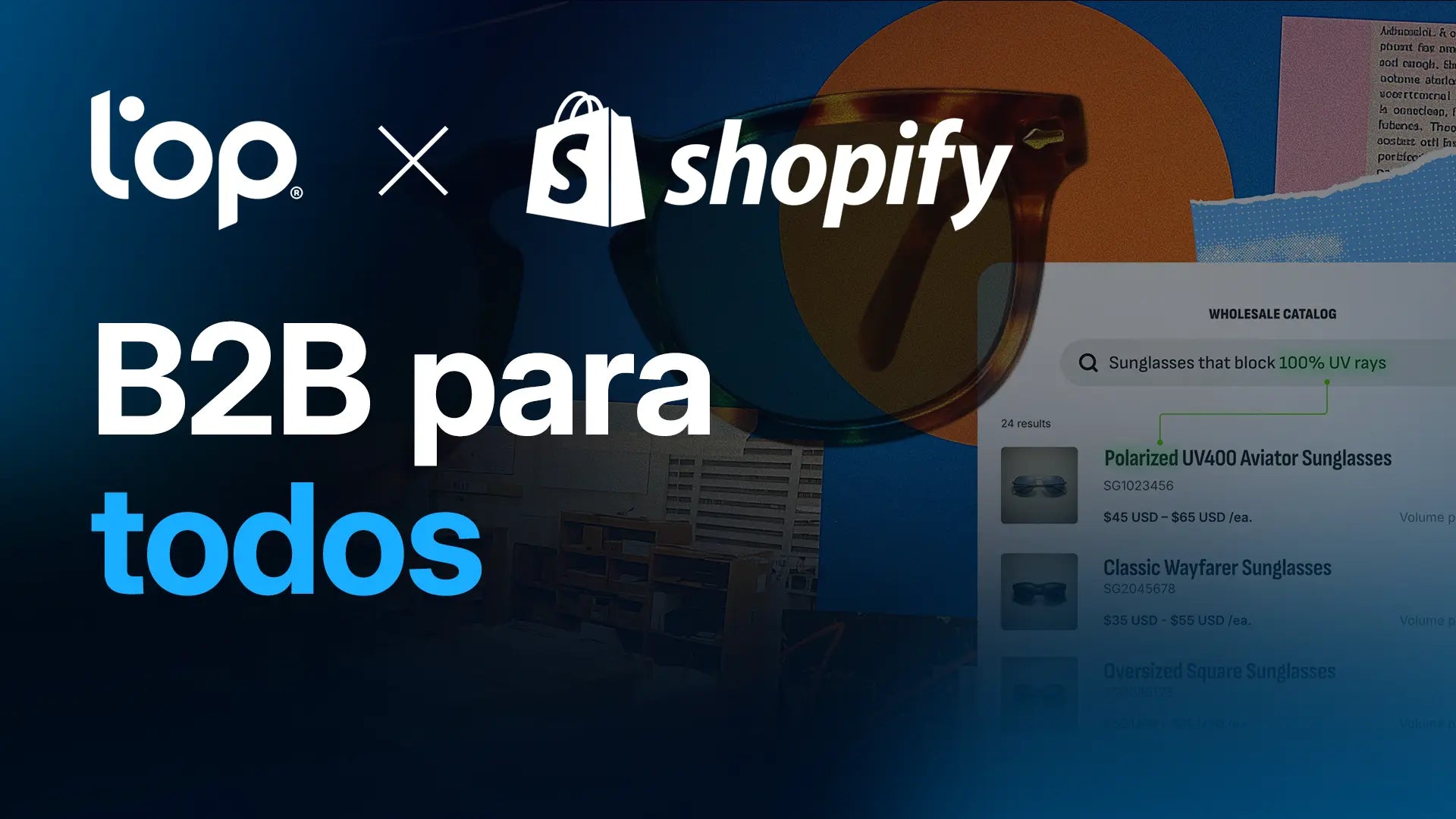
Shopify announced a key update: B2B functionalities are no longer exclusive to Shopify Plus and are now available on all its plans.
This is not a technical detail.
It's a structural change.
B2B is no longer a capability reserved for enterprise companies.
It is now accessible to any brand that currently sells B2C.
And there's a key point: the time for evaluation has passed. The context has changed.
Accessible B2B from the start
With this update, Shopify enables wholesale functionalities even on its most accessible plans.
Today, a brand can start exploring B2B from plans like Basic (starting at approximately USD 19 per month), without the need for a high initial investment.
This drastically reduces the barrier to entry:
- Lower cost
- Less complexity
- Faster implementation speed
The result is clear: B2B becomes viable much earlier in the business's lifecycle.
What B2B functionalities are enabled
Shopify incorporates native tools that allow operating wholesale models without external solutions:
Custom catalogs
Up to three catalogs with differentiated pricing based on customer or segment.
Company profiles
Management of corporate accounts with multiple users, roles, and locations.
Volume discounts and quantity rules
Volume-adapted pricing along with conditions such as minimums or purchase multiples.
Flexible payment terms
Options such as Net 30 or Net 60, aligned with B2B practices.
Securely saved payment methods
Facilitate re-purchases and optimize the experience for business customers.

What changes for B2C brands
The main impact is on brands that currently sell directly to consumers.
With this change:
- B2B is activated within the same store
- Without duplicating operations
- Without unnecessary technical friction
This allows for validating a wholesale channel more agilely, reducing implementation time and costs.
A new growth opportunity
The opening of B2B redefines the eCommerce landscape:
-
B2C brands that can expand to wholesale
-
Businesses looking to unify B2C and B2B
-
Companies that need differentiated commercial conditions
But there's a deeper change: the advantage now lies with those who move first.
Brands that activate B2B in this context will be able to build positioning and commercial relationships before others.
Shopify and the unified commerce model
This launch reinforces a clear vision for Shopify:
- Unify channels on a single platform
- Simplify operations
- Scale without complexity
B2B is no longer a separate channel.
It becomes a natural part of the sales ecosystem.
Conclusion
Shopify removes one of the main barriers to B2B: access.
The tools are available.
The cost of entry is low.
Complexity is reduced.
The scenario changes.
The time for evaluation has passed.
The time to act is now.
We are Shopify Plus Partners
We support brands looking to activate or scale their B2B model on Shopify, integrating operations, technology, and experience into a single strategy.
If you currently sell B2C and are considering adding B2B, this change opens up a concrete opportunity to do it right from the start.
Schedule a meeting with our team: https://lop.global/pages/contacto



Share:
Shopify Space: How to use data to sell more
Swissbrand Migrated from VTEX to Shopify in 15 Days and Achieved Record-Breaking Hot Sale Results